
 See Our Latest Article on HelloNation

Simple mobility exercises can help residents of Van Buren, NY move more comfortably during daily activities such as getting out of a chair, reaching overhead, walking, lifting household items, or preparing for seasonal outdoor work. Mobility is different from strength: it focuses on how freely and comfortably a joint or body region moves.
These exercises are intended for general wellness, not to diagnose or treat a specific injury. Move slowly, breathe normally, and stop if an exercise causes sharp, worsening, or radiating pain.
What is the difference between mobility and stretching?
Mobility exercises use controlled movement through a comfortable range. Stretching usually involves holding a position for a period of time. Both can be useful, but mobility work is often easier to include in a daily routine because it resembles ordinary movement.
For example, slowly turning the head, rotating the upper back, or moving the ankles prepares the body for activity without forcing a joint into an extreme position. Flexibility exercises may help joints move more easily, while regular physical activity supports strength, balance, and endurance. ([medlineplus.gov](https://medlineplus.gov/exerciseandphysicalfitness.html?utm_source=openai))
How should you prepare before exercising?
Begin with three to five minutes of easy movement. Walk around the house, march gently in place, or move the arms while standing. This is especially useful during colder months, when muscles and joints may feel stiff after time spent indoors or after sitting for extended periods.
A warm-up should gradually increase movement without causing fatigue. Avoid bouncing into a stretch or forcing a joint to move farther than it comfortably can. General exercise guidance recommends warming up first, stretching only after the body is warm, and stopping if pain develops. ([medlineplus.gov](https://medlineplus.gov/ency/patientinstructions/000859.htm?utm_source=openai))
Which simple exercises can improve everyday mobility?
The following sequence requires no special equipment. A sturdy chair or countertop can provide balance support.
1. Seated ankle movements
Sit with both feet on the floor.
- Lift one heel while keeping the toes down, then lower it.
- Lift the toes while keeping the heel down, then lower them.
- Make five slow ankle circles in each direction.
- Repeat on the other side.
This movement can be useful after sitting at a desk, riding in a vehicle, or spending time seated indoors. Keep the motion controlled rather than forcing the ankle into a large circle.
2. Sit-to-stand practice
Use a firm chair that does not roll.
- Place both feet about hip-width apart.
- Lean forward slightly while keeping the back comfortable.
- Stand up without pulling on the chair.
- Slowly sit back down.
- Repeat five to ten times, using the hands for support if necessary.
Sit-to-stand movement trains the hips, knees, and legs for common tasks. Keep the knees generally aligned with the feet and avoid dropping quickly into the chair. If balance is uncertain, position the chair near a stable counter or wall.
3. Shoulder blade movement
Stand or sit with the arms relaxed.
- Gently draw the shoulders up toward the ears, then let them relax.
- Move the shoulders backward in a slow circle.
- Bring the shoulder blades slightly toward each other without arching the lower back.
- Repeat five to ten times.
This can reduce the feeling of stiffness that develops after computer work, reading, driving, or household tasks performed with the arms in front of the body. The movement should be comfortable and should not create tingling, numbness, or pain down the arm.
4. Neck turns
Sit upright with the chin level.
- Slowly turn the head to look over one shoulder.
- Return to the center.
- Turn toward the other side.
- Repeat three to five times in each direction.
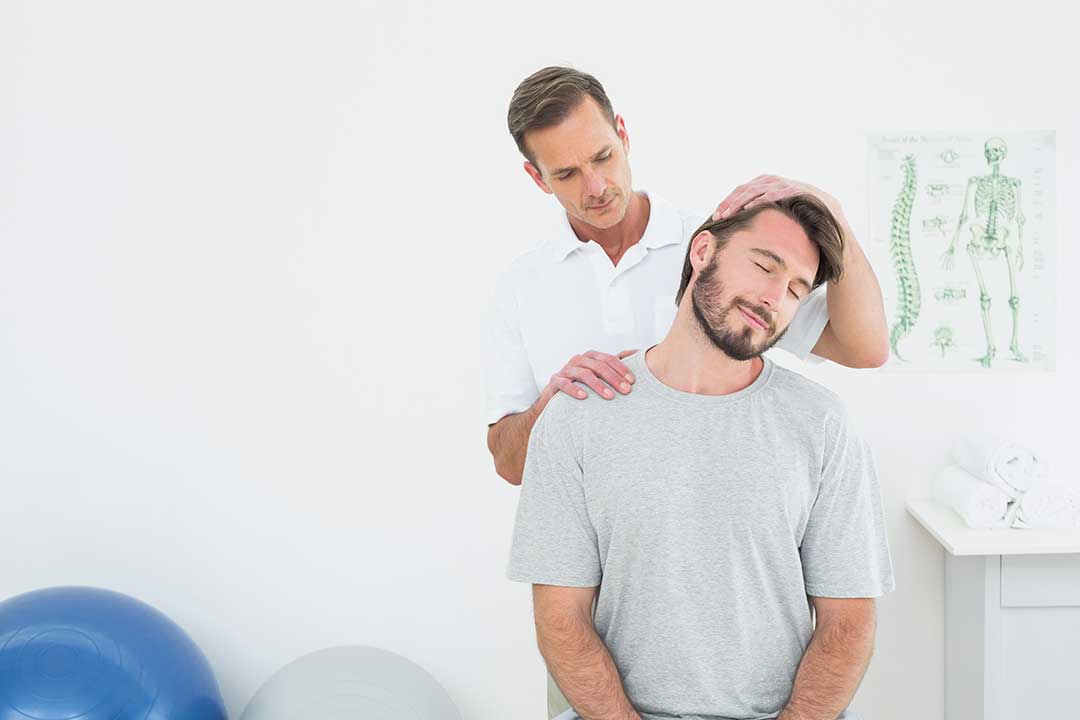
Do not force the head to rotate farther by using the hand. Stop if the movement causes dizziness, severe headache, arm symptoms, or unusual visual changes. Gentle neck movements are different from fast or forceful neck manipulation.
5. Upper-back rotation
Sit near the front of a chair with both feet supported.
- Cross the arms over the chest.
- Turn the upper body slightly to the right while keeping the hips facing forward.
- Return to the center.
- Repeat to the left.
- Perform five repetitions per side.
The goal is a smooth rotation through the upper back, not a large twist through the lower back. Keep the movement within a range that feels easy and controlled.
6. Pelvic tilts
Lie on the back with the knees bent and feet resting on the floor. If getting down to the floor is difficult, this exercise can be practiced in a supported seated position.
- Gently tighten the abdomen.
- Flatten the lower back slightly toward the floor.
- Relax back to a neutral position.
- Repeat eight to ten times.
The movement should be small. Do not hold the breath or press forcefully into the floor. People with a recent back injury, surgery, or significant pain should avoid adding new exercises without individualized guidance.
7. Supported hip movement
Stand behind a sturdy chair and hold it lightly.
- Move one leg slowly forward and back without leaning.
- Repeat five to ten times.
- Move the same leg gently out to the side and return it.
- Switch sides.
This exercise encourages comfortable hip movement while the chair provides balance. Keep the range modest and avoid swinging the leg.
How often should these exercises be done?
For general mobility, a short routine performed most days is often more practical than an occasional long session. Start with five to ten minutes and increase gradually if the body responds well. Walking at an easy pace can complement mobility exercises and support general conditioning.
Progress by adding repetitions slowly, not by forcing a deeper stretch. Avoid increasing the number of exercise days, duration, and intensity all at once. Gradual progression helps reduce the chance of overuse problems. ([medlineplus.gov](https://medlineplus.gov/ency/patientinstructions/000859.htm?utm_source=openai))
What sensations are normal, and what should prompt a stop?
A mild pulling sensation, gentle muscle effort, or temporary stiffness may occur. Sharp, stabbing, burning, or escalating pain is not a useful target. Stop the exercise if symptoms spread into an arm or leg, or if there is numbness, weakness, dizziness, chest discomfort, or unusual shortness of breath.
People who are pregnant, recovering from surgery, dealing with a recent injury, or managing a medical condition should obtain exercise guidance suited to their situation. The NHS also advises stopping immediately if exercise causes pain or makes a person feel unwell. ([nhs.uk](https://www.nhs.uk/live-well/exercise/exercises-sciatica-problems/?utm_source=openai))
When is at-home mobility not enough?
Seek prompt medical evaluation for severe pain after a fall or accident, inability to bear weight, a visibly deformed joint, new loss of bladder or bowel control, significant weakness, or numbness in the groin area. Persistent pain that does not improve with reasonable self-care also deserves assessment rather than repeated experimentation with exercises.
A mobility routine should make ordinary movement feel more manageable over time. It should not be used to push through an injury, replace evaluation of new neurological symptoms, or justify forceful movements that increase discomfort.
